Every fashion founder eventually has this argument with themselves: should the next $500 go into Meta, where you can see purchases by morning, or into connected TV, where the people who might become customers are actually relaxing?
The comparison fails when you score both channels on last-click ROAS. That metric is native to Meta and foreign to CTV. Here's how to run it honestly.
Meta (and TikTok) is a demand-capture machine. You upload creative, the auction finds responders, and you get purchases with tracking attached. Its weaknesses are the ones everyone knows: auction costs rise in fashion quarter, creative burns out in days, and attribution flatters it because clicks happen after other channels built the desire.
Connected TV reaches people on the biggest screen and asks nothing of them in the moment. Households watch premium content; you buy audience segments inside that viewing, say skincare obsessives or quiet luxury connoisseurs. There is no click. The effects arrive late: branded search rises, direct traffic rises, retargeting pools deepen, and Meta performance on the same creative often improves mid-flight because viewers have already heard of you.
Meta arm. $500 over 10 days buys roughly 125–330 clicks depending on market and CPC ($1.50–$4 is typical in US fashion). A few hundred responders: enough for early signal, not enough for certainty. You will learn whether your creative stops the thumb, whether the product page converts, what price framing works. Confidence: high, because purchases are directly tracked.
CTV arm. $500 at typical programmatic CTV rates buys tens of thousands of impressions, enough for a meaningful frequency burst in a defined segment if you keep geography or segment tight rather than spraying nationally. You will learn whether premium video moves demand signals in your market. Confidence: medium, because the measurement is lift-based, not click-based.
Neither arm "wins." They answer different questions, and the answers stack.
- Meta: blended ROAS on the test window (total store revenue ÷ total ad spend), not platform-reported ROAS alone.
- CTV: daily branded-search volume, direct sessions, and email signups during flight vs. the four weeks before. A visible mid-flight lift is your signal. Free tools are enough at this budget.
- Sequencing effect: if Meta CTR improves in week two of a CTV flight while your Meta spend is flat, that is the halo effect. Small brands miss it constantly.
Choose Meta first if: you have not proven product-market fit; your price point is impulse-friendly (under ~$50); your creative engine can produce 3+ assets a week.
Choose CTV first if: your differentiator is brand identity rather than price (sneaker culture, eco-conscious, pro-aging beauty are all identity purchases, and video shows identity in ways a static ad cannot); Meta costs have climbed past your contribution margin; you are entering a defined geography or moment (fashion week, festival season, World Cup summer).
Choose both if: you have $2,000+ per month. The standard small-brand shape is CTV or online video building reach in passion audiences, Meta capturing the response, retargeting closing it.
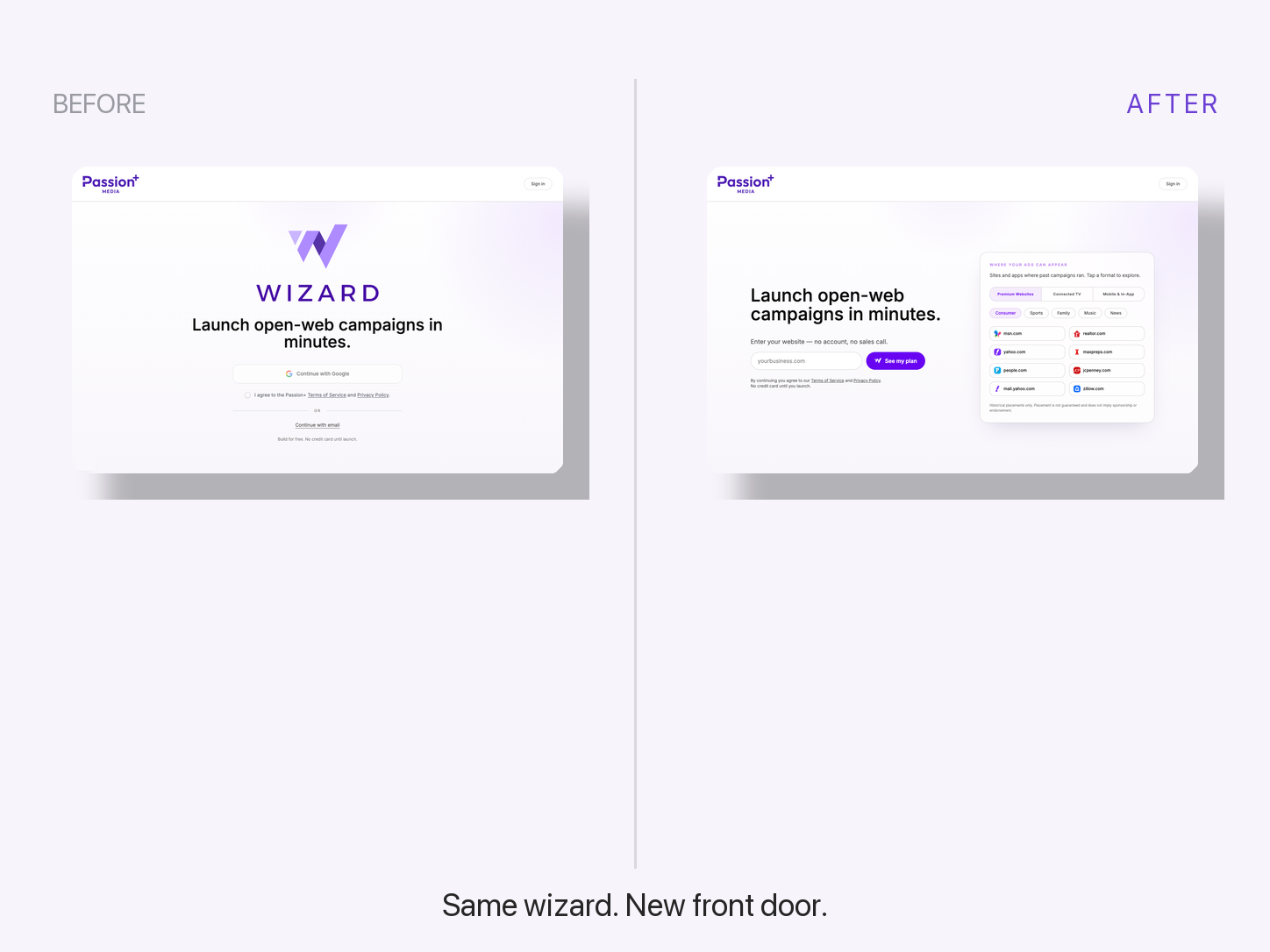
CTV used to be the channel you could not test. Agency minimums started where most small brands' entire quarterly budgets ended. That floor has collapsed: the Passion+ Fashion Wizard builds coordinated CTV, online video, and display plans from a few questions about your brand, audience, timing, and budget, with entry plans at $500. Small enough that the experiment above is possible without an agency conversation.
Meta answers whether people buy. CTV answers whether they show up looking for you later. Spend accordingly.