Running a first CTV campaign comes down to seven decisions, in order: pick a metric, set a budget, choose channels, pick an audience, build creative, watch the launch, read the results.
This guide walks through each one with real delivery numbers from our own $500 flight. The steps work for any brand. The numbers come from one house flight for a fashion brand, and this post flags exactly where that limits them.
Pick one primary metric (site visits, clicks, or sales) and write it down before you buy anything. Most first flights fail at the readout, not the delivery. With no metric picked up front, every number in the report looks like proof of something, and you find the one that flatters you.
A click is not a sale: people can like an ad and still leave your site empty-handed, so match the metric to the ask.
A $500 first flight can honestly answer one question: did this audience click? It cannot honestly answer the next: did they buy?
A real test starts at $500. Under that, you can't tell signal from noise. A small budget still buys impressions, but the samples come back too small to trust. Ten clicks on one line and seven on another is not a winner. It's dice.
At roughly a $9 blended CPM, $500 buys around 55,000 impressions. That is enough to read pacing, cost per impression, and click-through rate across a full flight.
The ladder above it: $1,000–$2,000 buys steady frequency on one or two audiences; $5,000 lets you run audiences side by side. How Much Does CTV Advertising Cost in 2026? breaks each tier down.
Start at the rung that lets you judge one thing well.
A first flight should mix display and connected TV, because each answers a question the other can't. Display is cheap reach where clicks are easy to count. CTV is attention on the big screen.
A useful split for a first test: 20–30% of impressions into CTV (enough weight for completion to mean something), with display carrying the volume you need to read click-through rate. Our flight ran 26% CTV at 98.9% completion on non-skippable inventory, 14,397 completed plays.
One channel alone gives half the picture: clicks without attention, or attention without clicks. Your first instinct may be to skip TV and just run social. Different screens do different jobs at different costs; a blended first flight lets you see both before you pick one.
Test one specific audience hypothesis, not a broad one — and if you can name a place where your buyers gather, geofence it. Our split test proved the point: geofenced display delivered 0.43% CTR versus 0.07% on broad interest targeting — 6x, with the same creative and the same publisher pool. The geofenced line took 134 of the campaign's 141 clicks.
A geofence audience is built from places. Ours used visits to fashion industry hubs like showrooms and market centers. Your version could be your own store district, a competitor's front door, or an event where your buyers gather.
Design for a screen with the sound off and the attention half-given. Three rules:
- Plan for sound off: captions or text must carry the message if nobody hears a word.
- Show the brand, one product, and one offer in the first three seconds — a TV viewer decides by second four whether you exist.
- Cut to 15 seconds unless the idea needs 30; a tight 15 usually lands harder than a loose 30.
We don't have creative-level test data yet; this is what we apply on every flight. Treat these as rules from people who ship ads, not results from a test.
Watch spend burn and frequency caps every day for the first three days. They tell you more than the last ten do. A flight that eats half its budget on day one never gets tested; it just ends early.
Pacing should hold even across the whole flight (ours ran about $38 a day, evenly, over thirteen days). Watch three things:
- Is spend pacing as planned?
- Is one person seeing the ad too often? For test budgets, cap frequency at 2–3 per day.
- Is any line clearly dead? A flat line for two days is noise; a dead line through day three is a signal.
If a line burns money with nothing back, pause it early. At test budgets, you will not rescue it later.
This daily watch is what managed buying earns its fee for: pacing, caps, and someone reading delivery reports while you run the business.
Separate view-through from click-through before you believe anything in the report. Someone who watched your ad and searched later shows up as a view, not a click; count both or you under-read video.
At $500 you can read pacing, cost per impression, completion, and how two audiences compare on clicks. What you cannot read is sales lift. Anyone quoting conversion results from a $500 test is selling you something.
The scientist's move: grade the flight only on the metric picked in step 1, write down one budget change the data supports, and make it in the next buy. Ours was moving the interest line's budget into geofence prospecting.
One decision per flight beats ten takeaways you will never act on.
Spend small, split one variable, and judge by the metric you picked in step 1.
- One flight, thirteen days, $500. A single test is a data point, not a curve. Repeat flights are needed to trust a trend line.
- Self-reported numbers on our own tooling. The delivery data comes from the DSP export a client sees. The reading of it is ours. Check it against your own flights.
- No conversion signal at this scale. Conversions were tracked, noise rather than signal at this scale, so they are not reported here. This post claims clicks and delivery, never sales lift.
- One vertical. The evidence comes from a fashion house flight. The seven steps work for any brand. The specific numbers may not.
Every step above is one you can take this week. Pick a metric. Set a $500 budget. Split one variable. Read the report like a scientist.
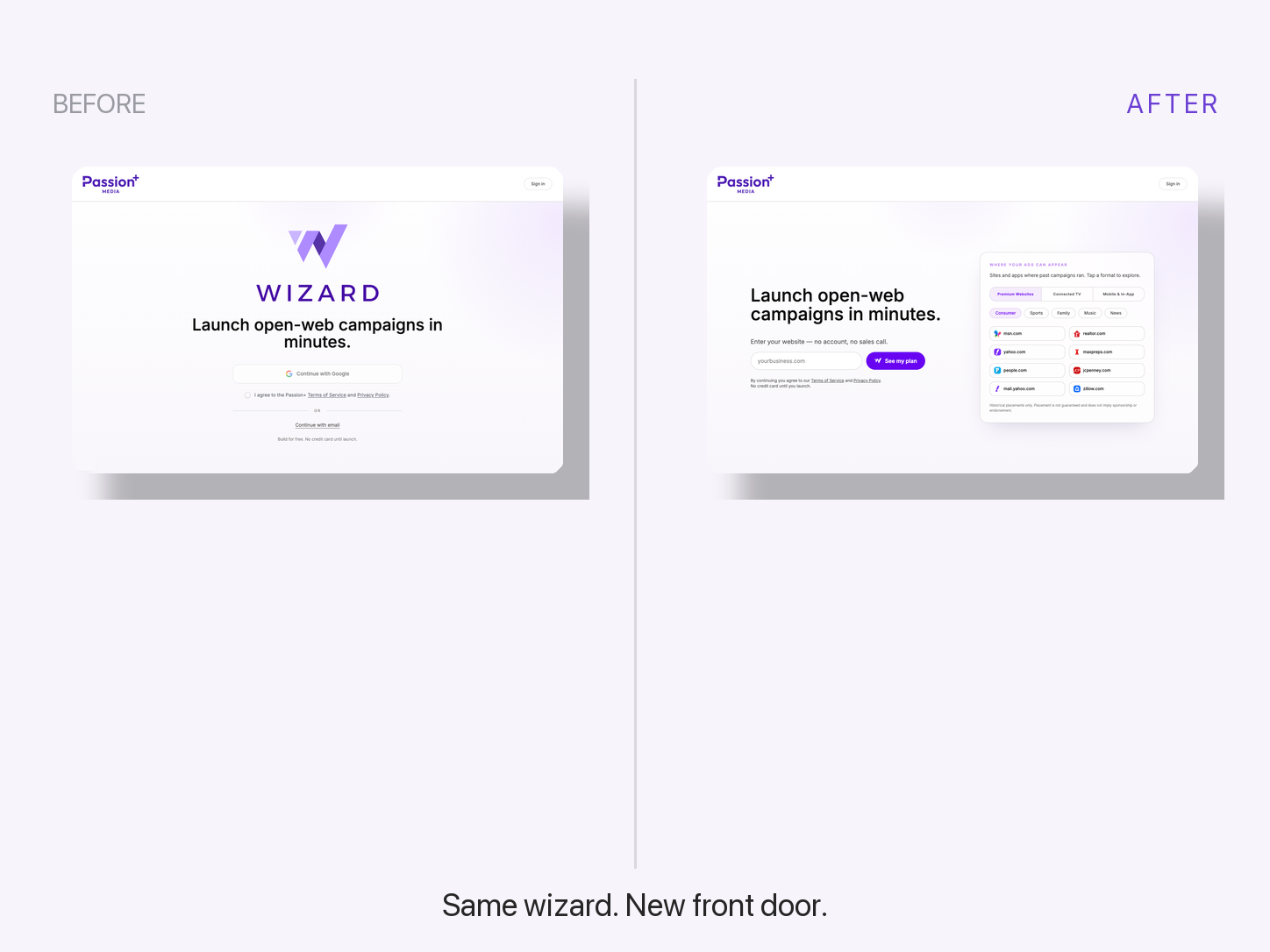
The Wizard builds that plan end to end from $500 — audience, channels, pacing, and reporting, ready to launch, with no retainer and no agency minimums.
Flight data: Pontiac DSP, campaign 14699, Aug 19–31, 2026.
Frequently asked questions
- How much does a first CTV campaign cost?
- Plan on $500–$2,000. That buys a clean test of one audience or one message over four to six weeks. Our own first flight ran on $500.05 and delivered 55,978 impressions. Our CTV cost guide breaks down what each budget tier buys.
- How long until I see results?
- Click-through rate and frequency are readable within days of launch. Conversion signal needs far more scale than a $500 test can buy. Judge a first flight on the metric you picked before launch, not on sales.
- Do I need my own ad server or DSP?
- No. That is what managed buying is for: someone picks the DSP, builds the audiences, caps frequency, and reports back. The Wizard builds that plan end to end from $500.
- Will CTV actually drive sales for a small brand?
- Honest answer: we tracked conversions in our $500 flight, and they were noise rather than signal at that scale. The value of a first flight is learning which audience and creative direction to scale next.