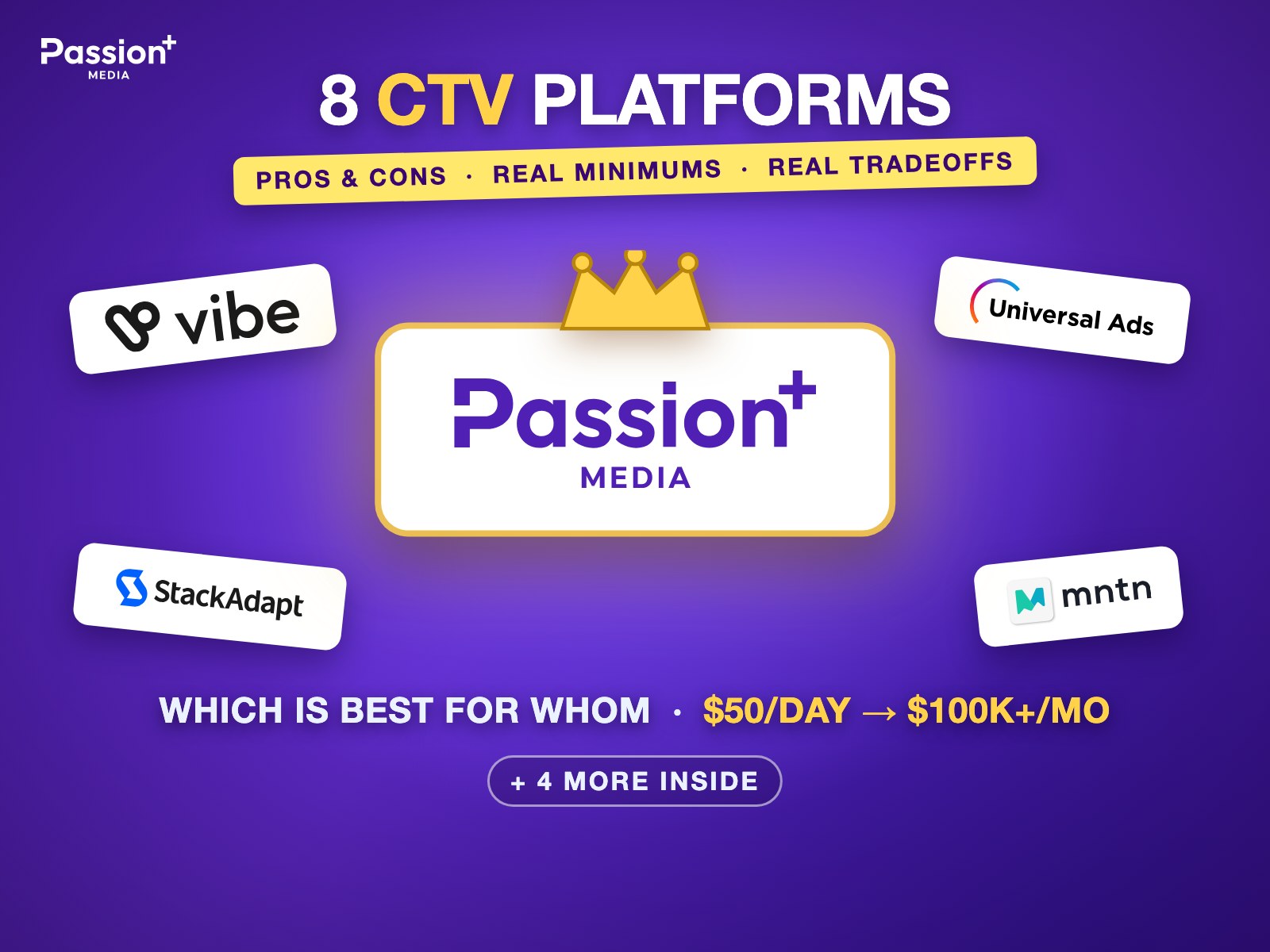
Your first CTV campaign can start at $50 a day or run six figures, depending on who you buy through.
One disclosure before we start: Passion+ is option 1 below, and we wrote this list.
All eight, with what each platform states or reports, checked October 2026.
| Platform | The good | The catch |
|---|
 | Free plan in minutes. Campaigns from $500. | Creative required to launch |
 | Lowest stated floor: $50 a day | DIY: you are the media team |
 | $100 start on curated premium TV | A Comcast walled garden |
 | No minimum, cancel anytime | Automation runs the show |
 | No minimums, deep functionality | DIY: human support gated by spend |
 | Pay per outcome, not per impression | Demo wall before pricing |
 | Integrates 250+ networks | Enterprise-first, self-serve waitlisted |
| Enterprise DSPs | Inventory others cannot reach | Fees and minimums vary by access route |
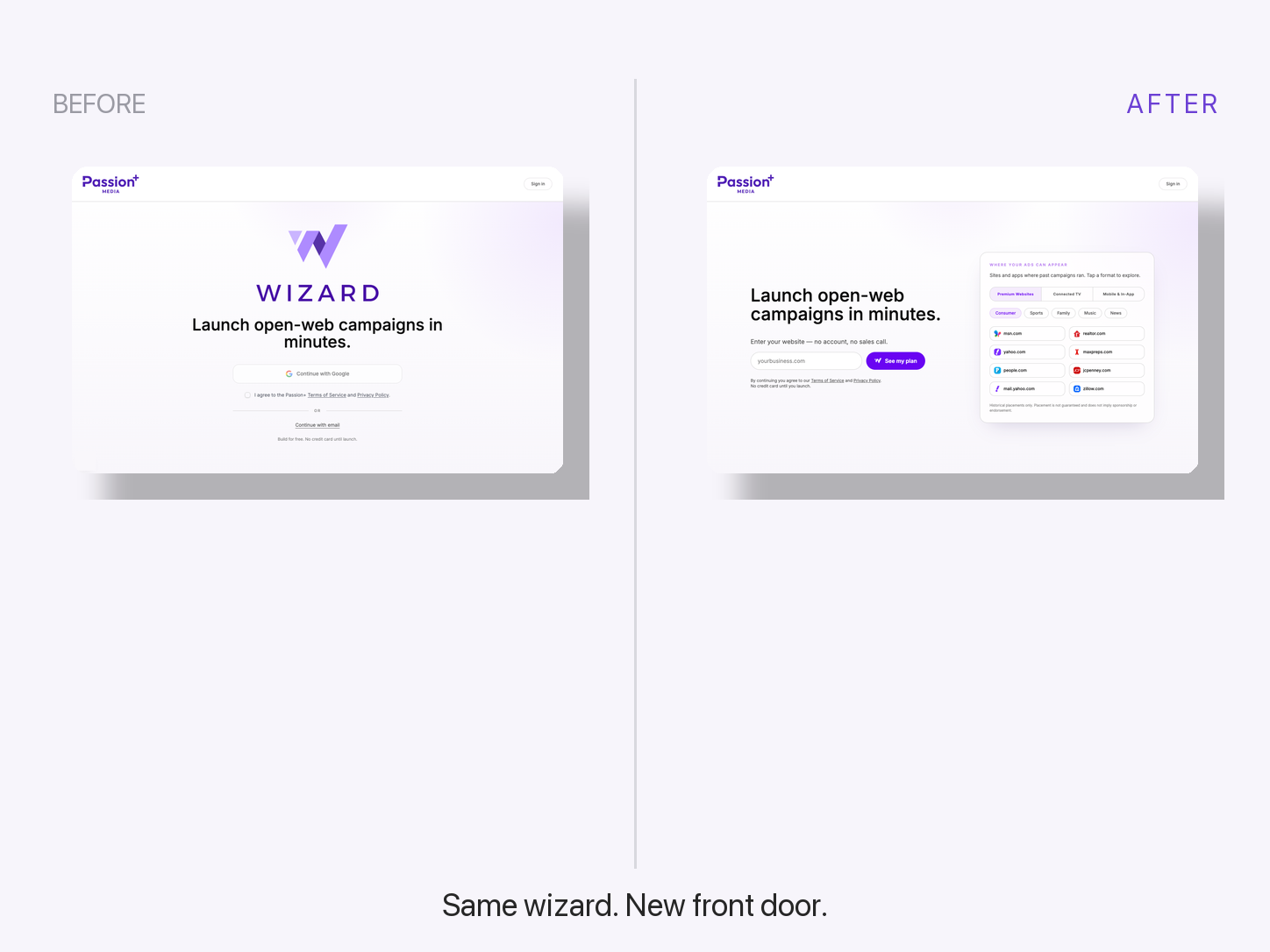
You know your brand. You do not need to know how to buy TV. If you have a collection, product launch or seasonal campaign to promote, the Wizard turns your website and a few answers into an audience and media-budget recommendation. Review and adjust the plan before deciding whether to launch. Planning is free; paid Wizard campaigns start at a $500 media budget, with no SaaS or subscription fees.
Fashion and beauty audiences make the start concrete: Skincare Obsessives, Sneakerheads & Streetwear, Athleisure & Activewear. The plan links your business, goal and geography to those audiences. It suggests a channel mix across CTV, online video and display. After launch, your dashboard tracks spend, delivery, clicks and video views. Other businesses can build a plan in the Wizard too. Want the team to run it? Managed advertising covers planning, setup and delivery for a separately agreed fee.
We ran our own $500 campaign across CTV and display. The campaign report covers the setup, delivery results and limits.
The catch: bring suitable creative before launch; creative production is quoted separately. Campaigns go live after payment and activation checks. If you need to buy through your own DSP, ask about agency and DSP deals.
Best if: you are a founder or small team planning a first campaign beyond paid social, especially in fashion or beauty. You have a product to promote and want a plan you can review without learning a DSP. Start with a free plan; ask about managed support if the team should run it.
$50 a day, no commitment, credit card or wire. Verified on Vibe's pricing page. Their budget tool shows CPMs from $15 to $35, depending on budget. It is the lowest published dollar floor in this list. StackAdapt states no minimum spend at all; tvScientific and Simulmedia publish nothing.
Vibe is self-serve: industry templates, built-in creative tools (Vibe Studio), campaigns that can run through AI agents, and no annual contracts. You can pause or scale mid-flight. It claims certified supply on 500+ premium streaming channels and names Disney+, Hulu, and YouTube. Since Walmart finished buying Vibe on Aug 4, 2026, Walmart Audiences is in early access: targeting built from real purchase data. No other platform on this list has that data.
The catch: it is CTV-only, with no linear, and Netflix and Prime Video are not in the published channel list. The ownership change is a real consideration too. If your brand competes with Walmart's retail business, check for conflicts before signing.
Best if: you want the smallest possible test, streaming-only is fine, and you want to launch today without a sales call.
Starts at $100 with no minimum commitment, no upfront contract, and no agency fee, per Comcast's own page. That is vendor-stated. We have no second source on what delivery looks like at that size.
Universal Ads is a fully self-serve marketplace built on FreeWheel, Comcast's ad-tech arm. The workflow feels like social ads. There is an in-platform AI video generator if you have no TV spot. CPM pricing, pause anytime. The inventory is a curated list of (NBCUniversal, Fox, Paramount, Warner Bros. Discovery, Roku, DIRECTV), claiming up to 90% of US households. Your :30 can run in the same break as national brands.
The catch: it is a curated slice, not an open exchange: Netflix, Amazon, Disney+/Hulu, and YouTube are all absent. The platform runs on Comcast's ad tech, and one named supplier, NBCUniversal, is a Comcast company. It is also young (launched Q1 2025), so there is little outside evidence on how it delivers at small budgets.
Best if: you want premium network inventory in a first flight and $100 is enough to start learning the format.
No upfront commitments. No minimums. and cancel anytime, quoted verbatim from mountain.com. MNTN is self-serve with AI-assisted planning and bidding: the platform builds the plan, you make the final call. It also includes creative tools (QuickFrame) for brands without a commercial yet.
Inventory is streaming-only, no linear. MNTN claims direct deals with 150+ streaming networks (Paramount+, Peacock, CBS, NBC, Roku, live sports). A competitor's comparison says programmatic-only. We could not settle that conflict, so treat it as a vendor claim. Confirm what you would actually get before you commit budget.
Measurement is the quiet strength: Verified Visits view-through attribution by default, an Attribution Paths report for cross-channel halo, and 25+ integrations (Google Analytics, Shopify, Triple Whale, Rockerbox, DoubleVerify). Deeper testing (incrementality) runs through third-party partners like Haus or LiftLab, at extra cost.
The catch: no published CPMs or fees. You can't model the real cost of a $500 test before signing up. Self-serve still means you set up tracking and read the reports yourself.
Best if: you are comfortable running it yourself and want automation to carry the planning and bidding.
No minimum spend requirement, and the entry tier takes a credit card, per StackAdapt's plans page. Their own plans table says what that entry tier really is: built for marketers who already have programmatic experience, with support at that level limited to Academy courses and a support portal. Account services start at the next tier up, and advanced analytics and attribution sit higher still.
The trade to understand: StackAdapt is an omnichannel DSP. Their own homepage lists CTV, video, display, native, audio, digital out-of-home, email, and direct mail on one platform, and in May 2026 they announced a technology partnership supporting advertising in ChatGPT. Useful if you want more than TV; CTV is not what the product is built around. Named premium CTV partners include NBCUniversal, A+E Networks, Xumo, BellMedia, Philo, and LG AdSolutions, plus a live sports calendar with free creative transcoding. Netflix, Amazon, Disney+/Hulu, and YouTube are not named. Cross-device attribution and Brand Lift studies are included.
The catch: pricing is quote-based. You can't see fees or CPMs without a demo. That is cost opacity at exactly the budget where it hurts most. Managed help appears only in higher tiers, so at $500–$2,000 you are on your own with good support docs.
Best if: you want the most channels in one self-serve account, and your team already has programmatic experience.
You can pay per outcome instead of per impression. tvScientific's "Guaranteed Outcomes" option lets you pick the result (sales, installs, traffic) and pay when it happens. Terms are custom and unpublished, so what counts as an outcome is set per account.
Pinterest closed its deal for tvScientific on Feb 17, 2026. The platform keeps running under that name. Inventory spans premium streaming and linear (93% of US households claimed), with suppliers including A+E, AMC, Bell Media, Bloomberg, and Charter/Spectrum. Since April 2026, you can target CTV with Pinterest's intent audiences: what people are planning to buy. That is a genuinely useful input for fashion and beauty brands.
Their measurement page describes patented household-level attribution linking ad exposure to online and offline conversions, plus incrementality and lift analysis, with a certified partner program for third-party validation. For a small brand trying to prove TV did something, that is the right tool.
The catch: it is not true self-serve. Onboarding is demo-led, with no public signup. No minimum spend is published anywhere. A competitor's "low four figures per month" entry claim is unverified; the platform may price out the bottom of your range before you find out.
Best if: you want to de-risk on outcomes and do not mind starting with a sales conversation.
250+ network integrations across broadcast, cable, and streaming, with unified frequency management on de-duplicated impressions across walled gardens. The core product, TV+, is managed and built for enterprise: it plans, runs, and measures linear + CTV together, using patented machine learning on their own viewership graph (over 2B events processed daily).
The self-serve path is Skybeam, launched November 2024 and expanded to broadcast and cable in November 2025. It works like Google and Meta ads. As of October 2026 it is on a waiting list at simulmedia.com.
The catch: pricing is unpublished for both products. The core service is built for brands and agencies with real budgets. Their platform page also reports down-funnel outcomes: incremental web visits, app installs, and purchases. For a $500–$2,000 first flight, you would be the smallest customer in the room, if you get access at all.
Best if: you are planning linear + CTV together as a program, not a test, and can wait for access.
Each of these three holds inventory nothing else on this list can touch. The Trade Desk calls itself "the preferred DSP for CTV" and lists 500+ sellers and publishers. Amazon (its DSP is folding into Amazon Ads Agent) sells Prime Video, Fire TV, Twitch, and shopping-intent data. DV360 buys YouTube and YouTube TV. These platforms offer broader buying tools for teams equipped to use them.
Why not first: access itself is gated, differently per vendor. Amazon's own access guide lists a $50K campaign minimum for Amazon-managed accounts and distinguishes partner-run routes that can carry no minimum (Amazon's guide). TTD runs through sales, with third-party reports of about $100K+ per quarter. DV360 access requires a Google Marketing Platform contract rather than an open signup. The TTD dollar figure is a third-party estimate; confirm current terms with the provider. On top of media, platform fees run 10–20% of spend: on a $1,000 flight, $100–$200 goes to the platform before a single impression. Most small brands reach Amazon DSP through agencies.
Look at these routes when you need what they offer: specific inventory, tools for an established media team, or control inside your own DSP. A bigger budget alone does not force a move. If your current platform or partner still fits, stay.
Best if: your team needs specific inventory, integrations or control in its own DSP, and has someone equipped to manage the buying.
What is the budget? Separate two numbers: what opens an account, and what answers your question. A small first flight can set delivery benchmarks. Split it across too many audiences and each line teaches you less. As spend grows, shop for support, inventory and reporting, not for a bigger platform by reflex.
Is there a media team? Decide what you can own: reviewing the plan, arranging tracking and following reports. Guided self-service can help a first-time buyer get started. If you want a team to handle planning, setup and delivery management, confirm the managed scope and costs.
What must TV prove? A small flight can show what delivery costs and whether video plays complete; a display line can also report clicks. Sales and lift questions need appropriate tracking, study design and enough data. Outcome-based pricing changes what you pay for, but does not itself establish incremental sales.
- Minimums change without notice. The source links above outdate faster than anyone would like. Re-check before you sign anything.
- The market is shifting fast. Two of the eight changed owners in ten months. A tool you pick this quarter may change hands by next.
- Some claims have no second source. Where that is true, it is marked in the text: vendor inventory claims are stated as claims, not facts.
- Our own entry carries a conflict of interest. The numbers that favor self-serve are in the table too. If a figure looks off, check the source: that is what they are for.
If your immediate priority is a test at $100 or less, Vibe and Universal Ads offer published entry points. If you want help turning your business and budget into a first media plan, start with your website in the Wizard. Review the recommended audiences, channels and budget, then decide whether to launch. Planning is free; paid Wizard campaigns start at $500.
Prefer the team to run the campaign? Discuss a managed brief, with scope and pricing agreed separately. The 7-step guide covers how to structure a first flight, and the cost guide explains what each budget tier buys.
Platform figures checked against vendor pages and primary sources on Oct 23, 2026. The TTD minimum is a third-party estimate; Amazon-managed and partner access terms are drawn from Amazon's access guide.
Frequently asked questions
- What is the cheapest way to test CTV in 2026?
- The lowest stated dollar floor is $50 a day on Vibe.co (now part of Walmart), with no commitment and credit-card payment. Comcast's Universal Ads starts at $100 with no agency fee, and MNTN and StackAdapt advertise no minimum spend. Our CTV cost guide covers what each budget tier actually buys.
- Can I run a real CTV campaign on $500?
- Yes. Our own first flight ran $500.05 over 13 days and delivered 55,978 impressions at an $8.93 blended CPM; read by line, CTV was 14,562 impressions at an $18.23 CPM completing at 98.9%, and both click-through lines were display. At that budget you can read pacing, cost per impression, completion, and how two audiences compare on clicks, not sales lift. The 7-step guide walks through it.
- Do I need an agency for my first CTV campaign?
- No. Passion+ Wizard guides you from your website to an audience and media-budget recommendation you can review and adjust without programmatic experience. Planning is free; paid Wizard campaigns start at a $500 media budget, with no SaaS or subscription fees. If you want the team to manage the work, managed advertising has separately agreed scope and pricing.
- Which CTV platforms have no minimum spend?
- MNTN and StackAdapt advertise no minimum spend, Vibe.co starts at $50 a day with no commitment, and Comcast's Universal Ads starts at $100 with no upfront contract. tvScientific and Simulmedia do not publicly state minimum spend requirements. Enterprise DSP access varies by route: Amazon-managed access has a stated $50,000 campaign minimum in its access guide, while partner-run routes can carry no minimum. Ask the provider for current terms.
- Is self-serve enough for a first CTV flight?
- Guided self-service can work for a first flight if you can review the recommendation and follow campaign reporting. You do not need DSP experience to build a free plan in Passion+ Wizard. If you need a team to handle planning, setup and delivery management, ask about a separately scoped managed campaign. Confirm responsibilities, tracking and costs before choosing either route.