
Local TV Is Back. It Starts at $500.
The neighbors have the TV on anyway. Let your shop be the name they know when they drive past

5 min read

Local TV is back, and for a local business it's better than ever. The biggest screen in most living rooms spent years showing ads from car dealers and candidates. Streaming brought the audience back to the big screen; programmatic made it targetable — a map and an audience dial, starting at $500.
Is Local TV Dead? No, Buying It Was
Local TV advertising is a video ad of yours, on the biggest screen in the room, shown to people close enough to walk in.
And we don't mean the 6 PM news. We mean the shows your neighbors actually sit down for: Game of Thrones on HBO Max, Sunday games on Paramount+, Love Island on Peacock, telenovelas and football on ViX. Same living rooms, same ad breaks — except the brand in the break can now be yours, not just the one with a six-figure minimum.
The audience is already there. Weekly streaming viewing among US internet users rose from 15.9% in 2020 to 36.6% in 2026 (GWI USA, 2020 & 2026) — 38 million people a week becoming 98 million. The direction is the point: the big screen has an audience again, and it's not just live broadcasts.
What died was the old way in. Local TV used to mean minimums in the thousands, a spot plan built by phone, broad targeting that reached a whole market, and an agency retainer to manage it. That door is still there if you want it. There are other doors now.
What Changed? Programmatic Reached the Big Screen
Programmatic buying is automated media buying: software picks the ad slot, sets the price and reports the result. On TV it means you can aim a big-screen buy the way you would aim an online video buy. Pick the area on a map. Layer an audience on top. Set how often one person sees it.
You buy like online video and it lands in the living room.
Here's how we do it in the Local Impact Package. The Wizard reads the address your business already publishes on its own site, so there's no new form to fill in. It comes back with one recommended area on a map, labeled in plain English: something like "22 miles around Stamford, including Bridgeport and Norwalk." The address found is echoed back as text, so a wrong read is visible before you buy.
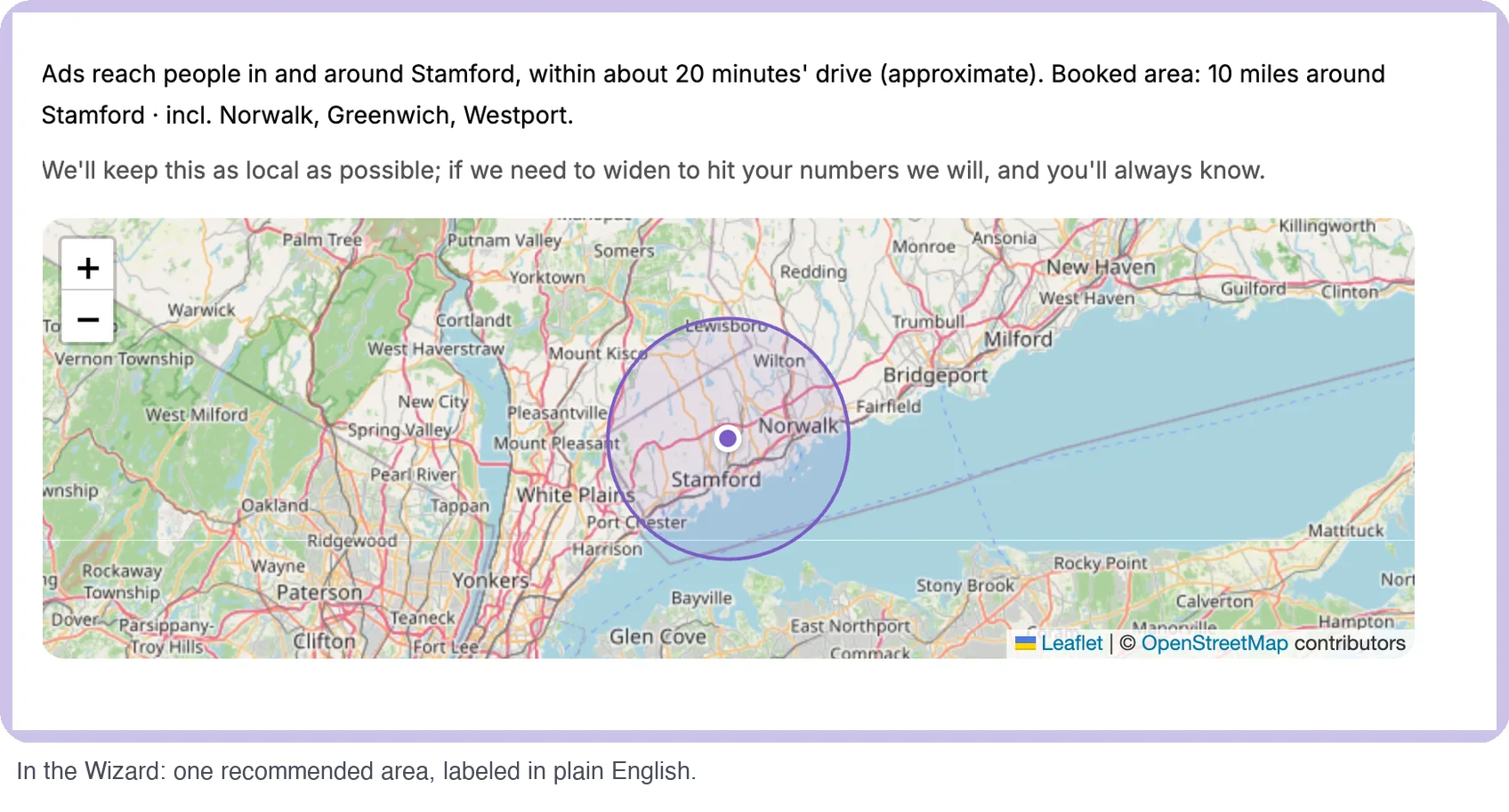
Under the map, an Adjust area dial runs from a tight cluster of zips out through the county, the metro, the state, the region and national. Slide it wider and you get more guaranteed impressions for the same budget. Multi-location businesses get one plan covering every store: one campaign, one budget.
A Different Lane Than Meta and Google
Attention on Meta and Google is bought in an auction, and that auction keeps getting pricier. Triple Whale's benchmark of 40,000+ brands across 17 industries puts Meta's median CPM up 13.24% year over year — $13.30 to $15.06, August 2025 through July 2026.
Local TV has its own local lane. It's quieter for a plain reason: until recently a small business could not get in. The minimum was the moat. Now $500 opens the door.
And geo is the part worth using. In our own $500 house campaign, audiences built from real location visits delivered a 0.43% click-through rate against 0.07% for interest targeting, on the same creative and the same publisher pool.
How Much Should You Spend? Three Rules of Thumb
Rule 1: $500 gets you in. Plans in the Wizard start at $500. A local TV flight used to start in the thousands, with an agency on retainer. Now $500 buys one area, one message and a real flight.
Rule 2: Buy repetition, not reach. One view rarely changes what someone does. Our planning starting point is about ten views a month. Our frequency calculator lays out three tiers: Light at 10, Medium at 20, Heavy at 30 views per person per month. A tight area is how you get there without paying to reach the whole country once.
Rule 3: Match the map to the money. Tight area, and the same people see you more. Wide area, and more people see you once. Same budget either way. Pull the Adjust area dial and watch the impression count move; that's the trade, in one line.
Build yours in the Wizard: free to plan, from $500 to launch.
What TV Costs Near You, Honestly
Say it before any quote does: TV is the premium screen. Full-screen, sound-on, in the living room. A plan built on it reflects that. The plan page shows your real number before you pay, so the number you argue with is yours, not a market band.
Three things we won't promise:
- No mileage guarantee. Our wording is impressions as close to your customers as possible. Programmatic inventory lives where publishers put it, not inside a circle drawn on a map.
- Tighter area means fewer impressions for the same money. That's arithmetic, not policy.
- Impressions aren't sales. A plan buys exposure near your customers. It doesn't claim attribution you didn't set up.
And on a tight plan: we will keep this as local as possible; if we need to widen to hit your numbers we will, and you will always know.
The Big Screen Is Open Again
Local TV is back. The audience is on the big screen, the buy has a map on it, and $500 gets you in. The lane is quiet because the door was locked for a long time. It's not anymore.
Build a plan in the Wizard from $500. It's free to plan, and the area dial is there to argue with.
For the cost side of the same decision, our CTV advertising cost guide breaks down what budget tiers buy. For how audiences behave once the map is set, our geofence campaign report has our own numbers. And our first-campaign walkthrough covers the flight structure before you need the map.
Source: GWI USA dataset, own analysis. Survey question: 'How often do you do the following?' — 'I watch shows via streaming or on-demand services weekly.' US internet users, 2020 vs 2026 waves. Meta benchmark from Triple Whale, August 17 2026.
Frequently asked questions
- How much does local TV advertising cost?
- A local TV plan starts at $500 in the Wizard. That's the entry point, not a price per thousand. TV is the premium screen; the plan page shows your real number before you pay.
- Can small businesses afford TV ads?
- Yes, at test size. $500 buys one area, one message and a real flight. What used to need an agency minimum and a retainer can now be planned and launched self-serve. Start with one area, read the result, then decide whether to widen.
- What is programmatic TV advertising?
- Programmatic TV advertising buys a big-screen ad slot through software instead of by phone. The buyer sets the area, the audience and the frequency cap; the platform buys the slot and reports the result. It's the online video buying model, aimed at the living-room screen.
- Do I need an agency for local TV ads?
- Not at test budgets. A self-serve plan builder gives you a readable plan and a delivery report from $500. Consider an agency when you need creative produced, several channels coordinated under one message, or someone to read the numbers each week.
Put what you’ve learned into a plan.
Explore an audience, budget, and channel mix for your business before you spend.
Build a free media plan
